Severn Tidal Barrage
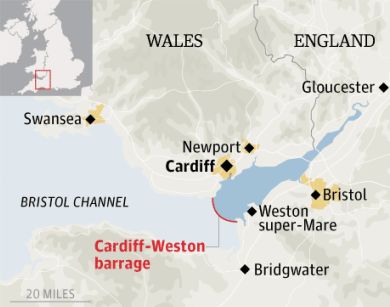
The Severn Tidal Barrage
The relatively small scale of many renewable energy generation projects, in contrast with traditional power stations, prevents them from benefiting from economies of scale. This is not a critism that can be levelled against Hafren Power's proposed Severn tidal barrage.
Propenents of the scheme argue that as a major infrastructure project, with the projected capability of producing 5% of the UK's electricity needs, the barrage would benefit from those economies of scale and, as a result, would keep prices down to make it one of the only truly cost-competitive renewable technologies. The strike price would be lower than offshore wind's and close to nuclear's. After the price-support period, it would generate virtually free electricity at around £20/MWh – less than half the cost of today's dirtiest fuel sources. They point to the example of Norway which invested in hydroelectricity some decades ago. Now, 98% of their domestic electricity comes from hydroelectric sources and their consumer electricity prices are 65% lower than in the UK.
The minimum lifespan of a barrage is 120 years, although engineers estimate 250 years to be more accurate. This compares well with the 60-year lifespan of a nuclear plant or 15 years for an offshore wind farm, and would mean that for at least 100 years, the barrage wouldbe generate the cheapest electricity in the UK.
The Severn tidal project would cost an estimated £30 billion and plans had been scrapped due to the adverse financial situation.
The plans envisaged a 10-mile long tidal barrage across the Severn Estuary stretching from Cardiff to Weston-super-Mare, incorporating some 200 turbines, able to generate about 5% of the UK's annual electricity requirements.
The project originally received government backing and would play a leading role in plans to meet climate-change targets (40% of UK electricity should be generated from renewable sources by 2020 if EU targets are to be met).
Opposition to the project has grown over recent years and a coalition of 10 groups including the National Trust, the RSPB and WWF (but not Greenpeace) say the barrage would be a mistake, both economically and environmentally.
The groups commissioned a report from the economics consultancy Frontier Economics, that concluded that more power could be generated more cheaply by using other green technologies.
The report argues that the financial cost of the project has been substantially underestimated and is likely to cost much more than the widely quoted £15bn. For instance that figure does not take into account the cost of land acquisition in Cardiff and Weston-super-Mare, or the creation of new wildlife habitats.
The report also argues that the cycle of the tides in the Severn means that a barrage would not necessarily provide electricity at peak times, and thus, the amount of power that the barrage would contribute to the National Grid has been over-estimated.
In terms of the environmental benefits of the scheme, the report says that huge amounts of CO2 would be emitted during the building of the barrage. An estimated 5m tonnes of CO2 during construction and another 5m tonnes emitted during transport of the materials.
The barrage would destroy nearly 86,486 acres (35,000 ha) of highly protected wetlands across the estuary. The land that would be submerged is home to about 68,000 birds in winter, including huge flocks of dunlins and shelducks, together with Bewick's swans, curlews, pintails, wigeons and redshanks. In summer, many breeding birds favor the estuary include curlews, shelducks and oystercatchers. The estuary is also important to sea-life and at least 30,000 salmon and tens of thousands of shads, lampreys and sea trout use the estuary to reach spawning grounds in the Usk and Wye rivers. Eels swim back down these rivers to reach spawning grounds at sea and millions of elvers return in the spring.